
Archive for the ‘Southern Trade Alliance (STA)’ Category
The Battle for the Kasbah
Wednesday, August 19th, 2026
Okay, the cat’s out of the bag: the Salt Ubar has a challenger.
The first major battle between the challenger’s followers and the combined forces of the Salt Ubar and the Southern Trade Alliance ended in a stalemate. The newly built kasbah could not be captured and once again controls the route to Klima.*
All prisoners on both sides were generously released – a sign of mutual respect. Given the very real and immediate threat from the north**, it would also be disastrous for the deep south to tear itself apart.
How does one become Salt Ubar? By becoming the most powerful man in the Tahari. And how does one achieve that? By gaining the support of the vast majority of the oases, regardless of tribal affiliation. So one must demonstrate diplomatic skill – this cannot be achieved through military means alone.
In any case, the STA will only cooperate with someone who can guarantee that the salt trade continues to thrive.
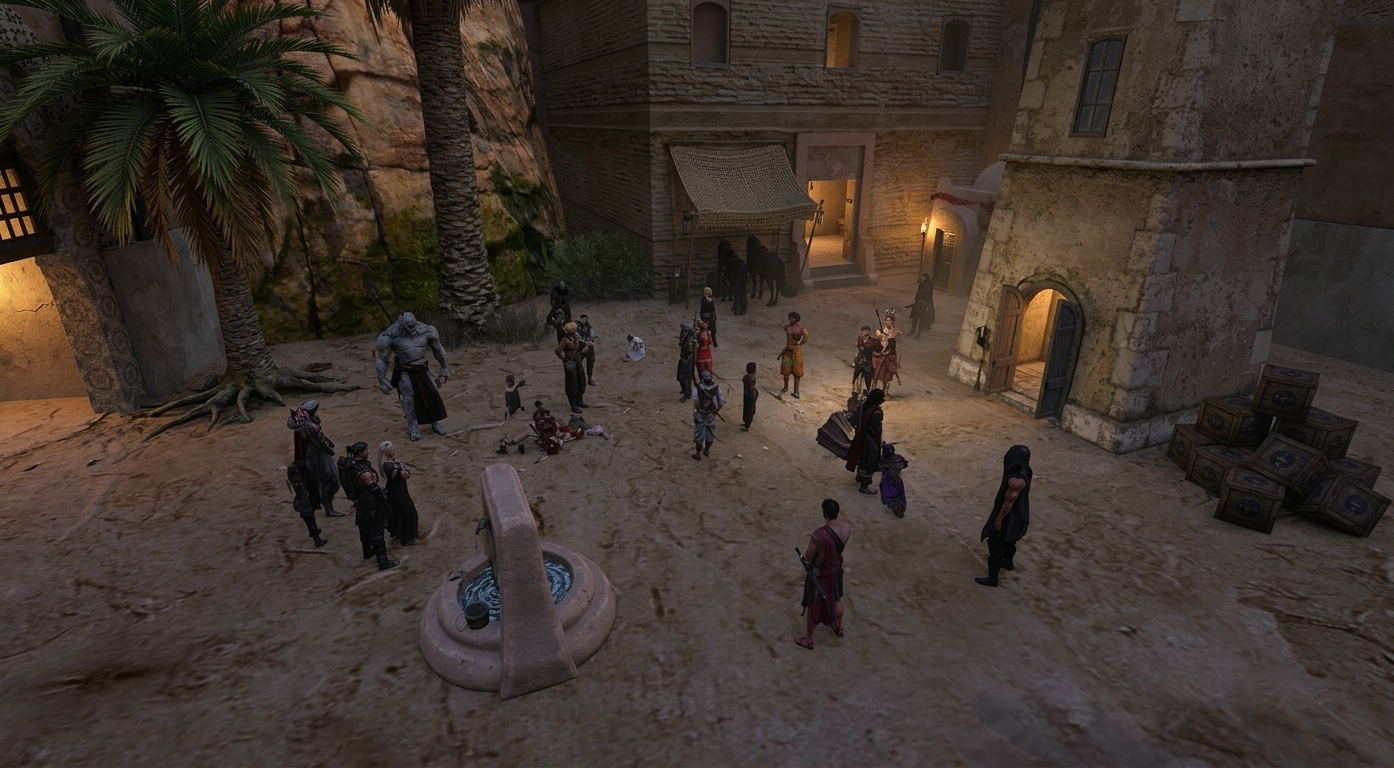
* Thanks to everyone who took part – we had two dozen fighters on the sim, which is an exceptional turnout for BTB Gor.
** Read the last two issues of the VOICE OF GOR regarding the threat from the north.
Expedition to the Northern Forests – Trade with panthers (part 2)
Sunday, July 12th, 2026
What Panthers Trade
Though many city merchants regard the Panther Girls merely as outlaws, experienced traders know that they possess a surprising variety of valuable goods. Any merchant willing to enter the northern forests under a flag of truce may find profitable exchanges.
The greatest share of Panther trade consists of products taken from the hunt. Fine pelts and furs are always in demand, together with bones, claws, teeth, and other animal by-products valued by craftsmen, leatherworkers, and artisans throughout Gor.
The forests also provide a wealth of useful plants. Panthers gather medicinal herbs, edible forest plants, and rare culinary herbs that are difficult to obtain elsewhere. Skilled healers and cooks often pay well for such supplies.

Many trade goods are acquired through raids or recovered from abandoned camps and caravans. Cloth, jewelry, tools, and various small luxury items frequently appear among Panther merchandise, often changing hands several times before reaching the cities.
Weapons are another common commodity. Panthers craft excellent bows, arrows, quivers, and hunting knives. Captured weapons taken from travelers, mercenary patrols, or defeated enemies may likewise be offered for trade if they are of sufficient quality.
A wise merchant does not overlook another valuable commodity: information. Panthers know the forests better than any mapmaker. They can reveal hidden trails, safe crossings, caravan routes, dangerous territories, the movements of armed bands, and the activities of outlaws. Such knowledge is often worth more than silver.

Finally, captives may also become objects of negotiation. Prisoners are sometimes ransomed, exchanged, or traded according to local custom and circumstance. On occasion, slaves or captured free persons may likewise form part of larger agreements between Panther bands and those willing to bargain with them.
Those who deal fairly, keep their word, and respect the customs of the forests may find the Panther Girls to be difficult, cautious, yet reliable trading partners. Those who attempt deceit seldom receive a second opportunity.

We had received information from scouts about the following groups of Panthers, but we didn’t know exactly where we would find them.: Sa’ng Gretuk Panthers, Zima Ak’am, Valkyrie Torva, Dani’s Band, Fitheach and Talender band, Shiva Sa’ng Fori and the Sa’Pansheen.

The trade was largely peaceful, although we were initially shot at during our first encounter with Panthers; luckily there were no injuries. Most of the groups that live in the forests offered us rare herbs that are not found in Central Gor and certainly not in the Tahari.

Navigating the small rivers of the northern forests with small but heavily laden boats proves difficult; rapids and fallen trees make passage challenging, and the outposts where the Panthers trade are sometimes so well hidden that only those familiar with the area can find them.

Most groups agreed to the deal not to pay for the trade goods we offered, except in kind, and to give the promise that STA merchants, if they displayed the STA flag, would receive preferential treatment and not be attacked.

But you can’t be sure. The northern forests are home to outlaws and outcasts…
Expedition to the Northern Forests – Trade with panthers (part 1)
Sunday, July 12th, 2026
After the supplies were loaded on board in the port of Gteletus, the STA merchants and friendsc set sail towards the Thassa, then along the coast to the northern forests. The “Lysander”, which was built to reach the Pani Islands, is the largest ship on Gor.

Even after we had passed the city of Lydius on the coast, we had the feeling of being watched from the shore.

The passage to the north is considered difficult to navigate. Often there is sudden heaving so that you can hardly see the coast and run the risk of being smashed on the sheer cliffs.

Some of the travelers watched the coastline drift by, relaxed. Others were occupied with the merchandise, some of which had been stowed on deck.

When some rock formations appeared, familiar to the sailors and the navigator, and announcing that the port of Kassau would soon be reached, most of the passengers rushed to the railing or the lookout and curiously observed the coastline.

Finally, the city came into view, and the huge ship was boarded outside the actual harbor. From there, boats took them to the docks.
Kassau sits on the northern edge of Gor’s great forests, northwest of the Thentis Mountains. Built mostly of wood, its tallest structure is the former temple, now the Merchant’s Hall, rising above the clustered homes below. Kassau’s warriors are called Axes; female slaves are bonds; male slaves are thralls. A sharpened-log wall surrounds the town, with nearby villages using Kassau as their market center.

Most of the goods are stored on the docks; rain is not expected at this time of year.

Many residents ran to the dock because they were curious about the huge ship and the travelers. Kassau is an associate member of the STA. Some of the merchants from Kassau had decided to join the expedition into the northern forests.

Aerial view of Kassau – you can clearly see Lysander in the back left.
STA Meeting in Teletus
Sunday, July 12th, 2026
The members of the Southern Trade Alliance (STA) met in Teletus to prepare for the expedition to the northern forests.
General Assembly of the Southern Trade Alliance (STA) in Kurtzal
Tuesday, May 5th, 2026
General Assembly of the Southern Trade Alliance – Kurtzal [04-18-2026]
2. AGENDA:
1. Report on the expulsion of the so-called Pasha of Klima (Rarius Yuroki)
2. Report on some misunderstandings in communication between the Salt Ubar and some oases (the Salt Ubar)
3. Report on the new STA members (Rarius Yuroki, delegations of the new members)
4. Discussion and vote on the contract signed by Selnar, allowing the STA to open a trading post there
5. The STA plans to equip an expedition to the northern forests to trade with panthers – discussion
Background: Presentation at the En’Kara Fair by Aηɢeʟ Kereꜱ Blades (angelkeres.nightwish)
6. Discussion on the hostile attitude of Ar’s Station and the Titus Brothers towards the STA
7. Discussion on access to the Exchange Point of the Oasis of Klima
Should every merchant trading in salt from Klima and traveling through the desert carry documents issued by the Salt Ubar?
8. Possible admission of new members
9. Distribution of the new salt bags from the Oasis of Klima, only to STA members
10. Miscellaneous

Before the event began, the Khan of Isfahan announced that Isfahan would leave the STA. He left the hall amidst a torrent of insults directed at Rarius Yuroki. Those present ignored his outburst.
1. Rarius Yuroki reported that the self-proclaimed Pasha of Klima had fled in the face of the overwhelming force advancing on Exchange Point and Klima.
2. The Salt Ubar addressed the desert leaders, warning that an illegitimate man has declared himself Pasha of Klima without proper communication reaching him. Because no message arrived, his forces did not intervene. He stresses that this breakdown in communication is dangerous and could threaten other regions. He expresses gratitude to those who acted in defense of Klima, calls it a sign of solidarity, but also a warning that messages must travel quickly. He emphasizes the need for protected caravans and active Dune Guards, and hopes the missing messenger is still alive or merely lost.
3. Delegations from the following were present:
Kurtzal, Oasis of Two Scimitars, Isfahan, The Kasbah (Salt Ubar), Oasis of Lame Kaiila and Oasis of Klima, Teletus, Lara, Oasis of Seven Palms. Oasis of Sand Sleen, Turia and Kassau were excused.
4. The delegation from Teletus assured them that their port was large enough for the “Lysander”. It was decided to send a delegation to Teletus to inspect the port.
5. It was decided that in approximately two months an official STA expedition would be equipped to the northern forests and the panthers there, in order to try to establish trade.
A possible starting point could be the port of Kassau, which is an associate member of the STA. Discussions were held about splitting into smaller groups and using smaller ships to reach the individual trading points.

6. + 7. Item 6 was postponed for several reasons, and some information is still lacking to make any decisions. Item 7 was also postponed because the topic will be addressed in the 10th Salt Decree, which is currently being drafted under the supervision of the Salt Ubar.
8. Agenda item 8 was cancelled
9. The new salt bags from the Oasis ok Klima have been presented; they bear the new STA logo and have been certified by the STA. The oases of the STA receive them free of charge, and STA members pay only half price, in accordance with the 9th Salt Decree. [“however you will handle that, prim coins, hud coins, emoting only”]
Negotiations in Selnar
Thursday, February 5th, 2026


After the Lysander was taken to the secret shipyard near Selnar, Rarius Yuroki sailed back to the port city once more. Negotiations began regarding both the treaty Selnar had concluded with the Southern Trade Alliance and Selbar’s membership in the STA. Discussions continued late into the night.
STA Meeting Oasis of Two Scimitars
Thursday, February 5th, 2026
…[12:14] Rarius Yuroki (yuroki.uriza): Report on the last march to Klima which did not went well:
[12:14] Rarius Yuroki (yuroki.uriza): Two months ago armed men gathered in the Oasis of Lame Kaiila. They had responded to a call to track down and capture a band of outlaws who, according to caravan leaders from the Oasis of Klima, were hiding near the Exchange Point.
The expedition was ill-fated from the very beginning. Everyone had hoped that Salt Ubar would send its elite troops, the Guards of the Dunes. But that didn’t happen. Consequently, there was a lack of organization and experienced military leadership.
[12:15] Rarius Yuroki (yuroki.uriza): But when we reached the enormous rocks that protect the Oasis of Klima from the sandstorms, and passed the well-known rocky outcrop, what many had feared came to pass: the outlaws had prepared and ambushed the expedition.
Fortunately, it turned out that the band of outlaws had arrived at the Exchange Point purely by chance and had no idea how to get back to an oasis or where the paths were. We pointed out to them that without the help of the locals, they would have perished miserably from thirst.
[12:16] Rarius Yuroki (yuroki.uriza): Someone offered to bring the outlaws back if they simply released the majority of the prisoners. There was supposedly a tunnel system near the ruins to bypass the quicksand. This was, of course, a trick and a lie, but the outlaws fell for it. In the labyrinth, which had already been explored several times, they managed to lead the outlaws astray. I have something else to say about the topic of outlaws. (…)
[13:27] Trygg Tyran (tryggtyran): “The Sardar Fair is fast approaching, and I am serving on the Fair Ubar’s council. I will programming activities for the merchant tent, as well as other activities. I will send a dispatch to the STA members with more details, but do be thinking of meetings and activities suited to the Sardar fair for this organization and the Gorean Merchants Association.”
[13:29] Trygg Tyran (tryggtyran): “Merchant’s Day at the Fair is ((Monday March 16)) But we can also do other activities on other days as well. I will send information, but if you haven’t reserved a tent, I have the necessary forms for it”
[13:34] Storm (tradino): stands, looking around and smiling to all, his loud and clear voice demanding the attention of all for a moment longer.
“For all that do not know me, I am Storm, one of the acting heads of caste, otherwise tavern keep.
After this extremely efficient meeting and on behalf of the Merchant Caste of the Oasis of Two Scimitars, do I want to thank you all for coming.
It was a pleasure to host this meeting and I would like to ask you to come back and spend some time to enjoy what our beautiful oasis has to offer, taking the opportunity to forge new trade connections.
For now I wish you safe paths home. May you always have water!”
Expedition to the Pani islands 5
Tuesday, December 16th, 2025
In the weeks that followed, the expedition did not limit itself to Nara alone. Guided by local pilots and charts newly amended with careful notes, the Lysander also sailed on to the neighboring islands of Kamura and Daphna, each different in custom and opportunity.

On Kamura, the visit was brief but cordial, marked by cautious exchanges and the promise of future contact. It was on Daphna, however, that events took a sharper and more memorable turn. The island was larger and more densely settled, its harbor watched over by the residence of its Shogun, a man known for his keen mind and firm rule. There, the members of the Southern Trade Alliance found themselves engaged in serious and promising trade discussions, speaking of routes, tariffs, and rare goods that might one day flow regularly across the Thassa.

The calm was broken one night by violence.
A group of rebels, their motives unclear but their intent unmistakable, launched an attack on the Shogun’s residence. Steel rang in the torchlight, and shouts echoed through the courtyards. Guards responded swiftly, and after a brief but fierce clash, the attackers were driven off or captured. The Shogun’s authority held—but not without cost.

One person was badly wounded in the fighting, struck deeply enough that death seemed close. There was no time to summon help from afar. Sabayna, the free companion of Rarius Yuroki, stepped forward without hesitation. Trained as a physician, she ordered water boiled, instruments cleaned, and space cleared. By lamplight, she performed an emergency operation, working with calm precision while soldiers stood watch at the doors.
The wounded survived.

In the days that followed, Sabayna’s skill drew attention not only for saving a life, but for her knowledge of healing arts. Daphna, it soon became clear, was rich in rare herbs and medicinal plants, many unknown or scarcely studied on the mainland of Gor. After careful thought, the physician made a decision: she would remain in Daphna until spring, to study these plants and expand her understanding of their uses.
The Shogun himself granted his approval—and more than that. He formally promised her protection, assigning guards and offering access to lands and gardens normally closed to outsiders. It was both gratitude and recognition of her value.
Thus, while ships and merchants prepared to sail on, a different kind of journey began—one of knowledge rather than trade. And on the island of Daphna, amid winter winds and quiet gardens, the bonds between strangers grew deeper, forged not only by commerce, but by courage, healing, and trust.

As winter tightened its grip on the Pani Islands, the time came to depart. The Lysander was the last ship able to leave before the season closed the seas with ice, storms, and treacherous winds. Her hull sat low in the water, fully laden with exotic trade goods—barrels of sake from Nara, rare items from Kamura, and carefully packed wares acquired through hard-won agreements in Daphna.
Farewells were spoken quietly. Sabayna remained behind under the Shogun’s protection, her work only beginning, while the rest of the expedition returned to the sea. With sails raised and anchors drawn, the Lysander slipped from the harbor and turned westward, setting her course for Selnar.

The Thassa, so cruel on the outward journey, showed a gentler face on the return. The winds were favorable, steady and strong, filling the sails and driving the ship onward day and night. The crew moved with renewed confidence, the weight of successful trade and survival lifting their spirits. Snow faded behind them, replaced by clearer skies and the familiar rhythm of open water.
Then, in the early light of dawn, a cry rose once more from the lookout—not of danger, but of home.
“Land ahead!”

Out of the pale morning mist, the coast of Cos appeared, dark and solid against the glowing horizon. Cliffs and shoreline took shape as the sun began to rise, painting the sea in bands of gold and blue. Men gathered at the rail in silence, many smiling, some whispering thanks to the winds and to the gods of Gor.

The long circle was nearly complete. From Selnar to the Pani Islands and back again, across storm, fog, snow, and steel, the Lysander had endured. Now, with Cos before her and Selnar close beyond, she carried not only cargo – but proof that the Thassa could be crossed, and that new paths of trade and alliance had truly been opened.

Ganima and Sabyna also contributed photos.
Expedition to the Pani Islands 4
Monday, December 15th, 2025
At dawn, two ships slipped from the harbor of Selnar and set their prows westward onto the Thassa, the vast and treacherous ocean of Gor. One was the Lysander, a heavy-bellied merchant vessel of the Southern Trade Alliance, its sails dyed deep brown; the other the Mjollner, a lean merchant ship, oars resting like folded wings along its sides. Though built for different purposes, the ships sailed together, bound by necessity and the uneasy trust of the Thassa.
By midday the wind freshened, snapping the sails and driving them forward across dark, rolling water. The sea smelled of salt and distance. Far from land, the Thassa revealed its first trial: a sudden storm rising as if summoned by unseen hands. Black clouds devoured the sky, and waves like moving hills crashed against the hulls. Men shouted, ropes burned hands, and the warship’s oars were pulled in lest they be torn away. For long hours the ships fought the storm, each moment balanced between survival and ruin.

When the storm finally broke, it left behind an unnatural silence – and fog. A pale, suffocating mist crept across the water, swallowing mast and sail until each ship was little more than a ghost to the other. Bells rang to keep them from collision, their dull tones echoing strangely in the white emptiness. In the fog, sailors whispered of sea serpents and lost islands, of ships that vanished forever upon the Thassa.
At last, the sun burned through the mist, and the fog unraveled like a dream at waking. The two ships emerged battered but afloat, their crews exhausted yet alive. Side by side once more, they continued westward, knowing that on the Thassa, survival itself was a quiet victory – and that the ocean was never truly finished with those who dared to cross it.

As the long voyage wore on, the two ships Lysander and Mjollnir cut steadily through the blue-gray swells of the Thassa. Days blurred into one another, measured only by the rising and setting of the sun and the creak of timber and rope. Faces grew lean, voices quiet, hope carefully guarded.
Then, one morning, a shout rang out from high above. “Land! Land to the south!”
The cry from the lookout shattered the weary silence. Men rushed on deck, shielding their eyes against the glare. At first there was only a thin, dark line on the horizon, but it was enough. A murmur spread across both ships, growing into laughter and shouted prayers of thanks.

As if the Thassa itself confirmed the news, birds appeared—white and gray shapes wheeling out of the sky. Several settled boldly on the rigging and even on the deck of the Lysander, cocking their heads and crying sharply. Sailors smiled at the sight. On Gor, birds resting upon a ship were a sure sign: land was close.

By midday, the sea began to change color, lighter and calmer, and then the islands rose from the water like green-backed beasts. The first islands of the Pani emerged through the haze—low hills crowned with palms, rocky shores kissed by white surf. Smoke curled faintly upward from somewhere inland.
A cheer rose from the Lysander, echoed moments later by the crew of the Mjollnir. Shoulders straightened, tired hands gripped the rail with renewed strength, and fear loosened its hold. The Thassa had tested them with storm and fog, but now it yielded its reward.
With the Pani Islands ahead and land within reach, the mood aboard both ships lifted like the sails in a fair wind, and for the first time in many days, the future felt close – and kind.

By sunset, the two ships reached a small harbor on one of the islands, which the charts named Nara. The light of the dying sun painted the shoreline in gold and red, revealing a quiet bay framed by dark stone and scattered palms. No signal fires burned, and no boats came out to greet them.
Caution prevailed. The Lysander and the Mjollnir dropped anchor farther out in the bay, where the water was deep and clear. No one knew whether the islanders of Nara were friendly, hostile, or something in between. Watches were set, weapons kept close at hand, and the ships rocked gently as night settled over the harbor.

The crews spent the night aboard. Some slept in narrow cabins below deck, while others stretched out in hammocks slung between beams, swaying softly with the motion of the sea. After the long crossing of the Thassa, even uneasy rest was welcome. Beyond the hulls, the island lay silent, its dark shape rising against a sky thick with stars.
At sunrise, the world revealed itself anew – and strangely so.

The harbor was calm and beautiful in the pale morning light, the water smooth as polished stone. But the air was sharp, biting at skin and breath. To the sailors’ astonishment, snow was falling, thin white flakes drifting down upon deck and sail. Frost rimed the ropes, and the wooden planks felt cold beneath bare hands.
Men stared in disbelief. Snow upon the islands of the Thassa was rare and unsettling, a reminder that Gor did not always obey expectation. Yet the sight was oddly peaceful: white flakes settling on green hills, cold air over a gentle sea.
Wrapped in cloaks and blankets, the crews watched the island of Nara awaken, unsure what the day would bring—but keenly aware that even after landfall, the world of Gor could still surprise them.

After some debate, it was decided that they would go ashore together. Two boats were lowered, and the landing party formed carefully. The men went first, armed and alert, spreading out as they reached the beach, ey
What awaited them was not steel or arrows—but smiles.
The people of Nara emerged openly from between the houses and terraces, unarmed, curious rather than fearful. They spoke in soft voices, pointing at the ships in the bay and at the strangers who had crossed the Thassa to reach their island. Children stared wide-eyed; elders nodded politely. Warm gestures replaced tension, and slowly, hands relaxed on sword hilts.

The surprise deepened when the Shugun of Nara himself appeared. He was a tall, broad-shouldered man, dressed in layered garments suited for both cold and war, a curved sword at his side. His presence carried weight—this was a ruler not unlike an Ubar of the great cities of the Gorian continent, a man accustomed to command and battle. Yet his expression was calm, even welcoming, and he greeted the leaders of the expedition with formal courtesy.

They were invited into a sturdy house near the harbor, built of dark wood and stone. Inside, the air was warm, and low braziers glowed softly. The travelers were seated on woven mats while servants moved quietly among them, pouring hot tea into simple cups. Steam rose, carrying a gentle, unfamiliar scent.
As they drank, stiffness eased from cold limbs, and words began to flow – careful at first, then more freely. Curiosity met curiosity. Stories of the Thassa, of storms and fog, were exchanged for tales of Nara and its winters by the sea.

What had begun as a wary landing ended in unexpected hospitality, and for the first time since leaving the mainland, the expedition felt not merely tolerated – but truly welcome.
Before long, the conversations turned from pleasantries to the true purpose of the voyage: trade.
The leaders of the expedition spoke of the Southern Trade Alliance, of long routes across sea and desert, and of goods carried from lands far beyond the horizon. When the chests were opened and the cargo revealed, there was a quiet stir among the people of Nara. Most impressive of all was the salt of the Tahari – coarse, white, and unmistakably real. On Gor, such salt was precious, especially beyond the great deserts where it was born.
The Shugun examined it closely, letting the crystals run through his fingers. He nodded, clearly understanding its value. In return, the people of Nara brought forward their own treasure: barrels of sake, carefully sealed, the wood darkened by age and sea air. The scent alone spoke of skill and patience, of rice and water shaped by long tradition.
The agreement was made without raised voices or drawn steel. Several barrels of sake were exchanged for the Tahari salt, each side satisfied that the balance was fair. Seals were marked, witnesses noted, and servants moved the goods with practiced care.

Warm cups were refilled as the mood in the house grew lighter. What had begun as a perilous crossing of the Thassa had led, at last, to successful commerce. The Southern Trade Alliance had opened a new door, and Nara, snow-dusted and distant, had proven itself not a threat—but a partner.
As the tea and sake were shared, it became clear to all present that this meeting was more than a single exchange of goods. It was the beginning of a route, a promise carried across the cold sea by the Lysander and the Mjollnir, and by the fragile but powerful bond of trade.
Expedition to the Pani Islands 2
Saturday, December 6th, 2025
Word spreads along the docks of Selnar like sparks on dry parchment – the Southern Trade Alliance vessel, Lysander, has slipped into port under a bright Imperial sun and now rests at anchor in the harbor.
No official announcement preceded it.
No courier rode ahead.
No herald arrived to prepare the city.
The Lysander simply appeared at dawn’s first light – its sails furled in disciplined lines, its sail marked with the familiar sigil of the Southern Trade Alliance.
Merchants gradually arrived and unloaded crates and barrels destined for the Lysander at the docks.

The Lysander is so huge that it doesn’t fit into the harbor of the Ubarate of Cos and therefore had to anchor in the outer harbor where the water is deep enough. On the second day, several merchants arrived by boat to inspect the ship.

On the evening of the second day, another ship arrived, the Mjollnir, belonging to the White Tarn Mines Company. The passengers and slaves soon rowed to the Lysander, as they too wanted to travel to the Pani Islands.

The mooring fee for the ship and the fee for stacking the crates and barrels at the docks was quite high. One had to pay two silver Tarsks – as much as a warrior’s monthly wage.

Meanwhile, the ship filled with passengers who spread out over the two decks below the main deck, in the cabins and in the hammocks. A member of the black caste appeared and spread fear, but fortunately it turned out that the man had been hired to protect the HoY Company, i.e., he was under contract.

In the evening, members of the white caste, including the Initiate from Isfahan and an Initiate from Selnar, bestowed blessings for the journey and wished the expedition good luck and success.

Shortly before dusk, the passengers gathered on deck and discussed what to do, as the captain had not yet arrived. Some knew how to sail a ship, but they were unsure of the exact direction.

It was decided to hoist the sails, weigh anchor, and slowly sail towards the Pani Islands, hoping that the missing captain would be able to find a fast sailing vessel in the port of Selnar to join the expedition.

As the last rays of the sun faded, the sails unfurled, displaying the proud symbol of the Southern Trade Alliance. They sailed out past the bustling port of Selnar, hoping the weather would be favorable for the expedition.

Soon night fell and the stars shone above the Lysander. A sailor’s voice could be heard singing a song and others joined in during the chorus.

Upon the Thassa, dark and wide,
where roaring winds take hold,
we cast our fate to wave and tide,
to waters deep and cold.
The timbers groan, the sail-cloth strains,
yet still we onward steer;
for every man of Gor remains
too proud to bow to fear.
Oh Thassa blue, oh Thassa gray,
your song is fierce and free.
We brave your wrath, we dare your might,
great ancient, endless sea!
A shadow circles round our keel,
a hunter of the deep.
The deck is slick with salt and steel,
and no man dares to sleep.
The storm above begins to roar,
it tears the sky apart;
but Gorean men endure far more –
with fire in every heart.
Oh Thassa blue, oh Thassa gray,
your song is fierce and free.
We brave your wrath, we dare your might,
great ancient, endless sea!
Through shattered clouds a pale star gleams,
a guide for those who roam.
It leads us past the Thassa’s schemes
and whispers, “Sail for home.”
Yet should her call return once more,
we’ll answer without shame;
for men who voyage out from Gor
are bound to sea and flame.
Oh Thassa blue, oh Thassa gray,
we heed your timeless plea.
When next you call, we sail again –
proud sons of Gor on sea!