
Expedition to the Pani Islands 4

At dawn, two ships slipped from the harbor of Selnar and set their prows westward onto the Thassa, the vast and treacherous ocean of Gor. One was the Lysander, a heavy-bellied merchant vessel of the Southern Trade Alliance, its sails dyed deep brown; the other the Mjollner, a lean merchant ship, oars resting like folded wings along its sides. Though built for different purposes, the ships sailed together, bound by necessity and the uneasy trust of the Thassa.
By midday the wind freshened, snapping the sails and driving them forward across dark, rolling water. The sea smelled of salt and distance. Far from land, the Thassa revealed its first trial: a sudden storm rising as if summoned by unseen hands. Black clouds devoured the sky, and waves like moving hills crashed against the hulls. Men shouted, ropes burned hands, and the warship’s oars were pulled in lest they be torn away. For long hours the ships fought the storm, each moment balanced between survival and ruin.

When the storm finally broke, it left behind an unnatural silence – and fog. A pale, suffocating mist crept across the water, swallowing mast and sail until each ship was little more than a ghost to the other. Bells rang to keep them from collision, their dull tones echoing strangely in the white emptiness. In the fog, sailors whispered of sea serpents and lost islands, of ships that vanished forever upon the Thassa.
At last, the sun burned through the mist, and the fog unraveled like a dream at waking. The two ships emerged battered but afloat, their crews exhausted yet alive. Side by side once more, they continued westward, knowing that on the Thassa, survival itself was a quiet victory – and that the ocean was never truly finished with those who dared to cross it.

As the long voyage wore on, the two ships Lysander and Mjollnir cut steadily through the blue-gray swells of the Thassa. Days blurred into one another, measured only by the rising and setting of the sun and the creak of timber and rope. Faces grew lean, voices quiet, hope carefully guarded.
Then, one morning, a shout rang out from high above. “Land! Land to the south!”
The cry from the lookout shattered the weary silence. Men rushed on deck, shielding their eyes against the glare. At first there was only a thin, dark line on the horizon, but it was enough. A murmur spread across both ships, growing into laughter and shouted prayers of thanks.

As if the Thassa itself confirmed the news, birds appeared—white and gray shapes wheeling out of the sky. Several settled boldly on the rigging and even on the deck of the Lysander, cocking their heads and crying sharply. Sailors smiled at the sight. On Gor, birds resting upon a ship were a sure sign: land was close.

By midday, the sea began to change color, lighter and calmer, and then the islands rose from the water like green-backed beasts. The first islands of the Pani emerged through the haze—low hills crowned with palms, rocky shores kissed by white surf. Smoke curled faintly upward from somewhere inland.
A cheer rose from the Lysander, echoed moments later by the crew of the Mjollnir. Shoulders straightened, tired hands gripped the rail with renewed strength, and fear loosened its hold. The Thassa had tested them with storm and fog, but now it yielded its reward.
With the Pani Islands ahead and land within reach, the mood aboard both ships lifted like the sails in a fair wind, and for the first time in many days, the future felt close – and kind.

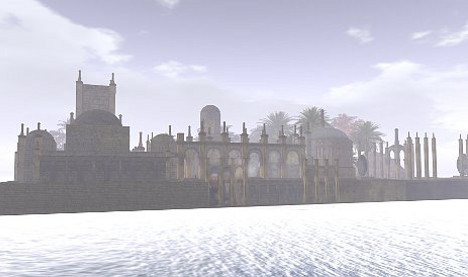
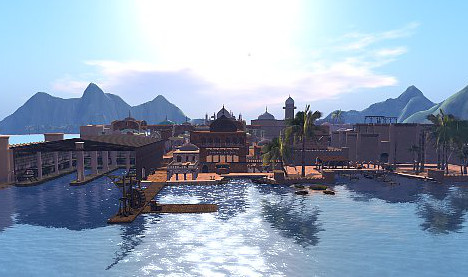
By sunset, the two ships reached a small harbor on one of the islands, which the charts named Nara. The light of the dying sun painted the shoreline in gold and red, revealing a quiet bay framed by dark stone and scattered palms. No signal fires burned, and no boats came out to greet them.
Caution prevailed. The Lysander and the Mjollnir dropped anchor farther out in the bay, where the water was deep and clear. No one knew whether the islanders of Nara were friendly, hostile, or something in between. Watches were set, weapons kept close at hand, and the ships rocked gently as night settled over the harbor.

The crews spent the night aboard. Some slept in narrow cabins below deck, while others stretched out in hammocks slung between beams, swaying softly with the motion of the sea. After the long crossing of the Thassa, even uneasy rest was welcome. Beyond the hulls, the island lay silent, its dark shape rising against a sky thick with stars.
At sunrise, the world revealed itself anew – and strangely so.

The harbor was calm and beautiful in the pale morning light, the water smooth as polished stone. But the air was sharp, biting at skin and breath. To the sailors’ astonishment, snow was falling, thin white flakes drifting down upon deck and sail. Frost rimed the ropes, and the wooden planks felt cold beneath bare hands.
Men stared in disbelief. Snow upon the islands of the Thassa was rare and unsettling, a reminder that Gor did not always obey expectation. Yet the sight was oddly peaceful: white flakes settling on green hills, cold air over a gentle sea.
Wrapped in cloaks and blankets, the crews watched the island of Nara awaken, unsure what the day would bring—but keenly aware that even after landfall, the world of Gor could still surprise them.

After some debate, it was decided that they would go ashore together. Two boats were lowered, and the landing party formed carefully. The men went first, armed and alert, spreading out as they reached the beach, ey
What awaited them was not steel or arrows—but smiles.
The people of Nara emerged openly from between the houses and terraces, unarmed, curious rather than fearful. They spoke in soft voices, pointing at the ships in the bay and at the strangers who had crossed the Thassa to reach their island. Children stared wide-eyed; elders nodded politely. Warm gestures replaced tension, and slowly, hands relaxed on sword hilts.

The surprise deepened when the Shugun of Nara himself appeared. He was a tall, broad-shouldered man, dressed in layered garments suited for both cold and war, a curved sword at his side. His presence carried weight—this was a ruler not unlike an Ubar of the great cities of the Gorian continent, a man accustomed to command and battle. Yet his expression was calm, even welcoming, and he greeted the leaders of the expedition with formal courtesy.

They were invited into a sturdy house near the harbor, built of dark wood and stone. Inside, the air was warm, and low braziers glowed softly. The travelers were seated on woven mats while servants moved quietly among them, pouring hot tea into simple cups. Steam rose, carrying a gentle, unfamiliar scent.
As they drank, stiffness eased from cold limbs, and words began to flow – careful at first, then more freely. Curiosity met curiosity. Stories of the Thassa, of storms and fog, were exchanged for tales of Nara and its winters by the sea.

What had begun as a wary landing ended in unexpected hospitality, and for the first time since leaving the mainland, the expedition felt not merely tolerated – but truly welcome.
Before long, the conversations turned from pleasantries to the true purpose of the voyage: trade.
The leaders of the expedition spoke of the Southern Trade Alliance, of long routes across sea and desert, and of goods carried from lands far beyond the horizon. When the chests were opened and the cargo revealed, there was a quiet stir among the people of Nara. Most impressive of all was the salt of the Tahari – coarse, white, and unmistakably real. On Gor, such salt was precious, especially beyond the great deserts where it was born.
The Shugun examined it closely, letting the crystals run through his fingers. He nodded, clearly understanding its value. In return, the people of Nara brought forward their own treasure: barrels of sake, carefully sealed, the wood darkened by age and sea air. The scent alone spoke of skill and patience, of rice and water shaped by long tradition.
The agreement was made without raised voices or drawn steel. Several barrels of sake were exchanged for the Tahari salt, each side satisfied that the balance was fair. Seals were marked, witnesses noted, and servants moved the goods with practiced care.

Warm cups were refilled as the mood in the house grew lighter. What had begun as a perilous crossing of the Thassa had led, at last, to successful commerce. The Southern Trade Alliance had opened a new door, and Nara, snow-dusted and distant, had proven itself not a threat—but a partner.
As the tea and sake were shared, it became clear to all present that this meeting was more than a single exchange of goods. It was the beginning of a route, a promise carried across the cold sea by the Lysander and the Mjollnir, and by the fragile but powerful bond of trade.
Leave a Reply
You must be logged in to post a comment.